Egg Chase Base Race


Egg Chase Base Race
 

State Standard: 1, 3, & 4

Equipment: Batting tees (1 per group), Foam or whiffle balls, Large Poly Spots (to mark bases), Plastic Easter eggs (10–20 per group), A few Golden Ticket” eggs, Buckets/baskets (we use the large cubstakes), Tootsie Rolls (or small prizes). Grade: K-5
Purpose of Event: Students will strike a ball, run bases quickly, and make safe decisions while working cooperatively in a fun, Easter-themed game.
Time: 18-25 minutes

Organization:

Students are organized into small groups of one to two per station and arranged in a relay-style formation. Each station includes one tee, one batter, and one outfielder who stands on a large poly spot, along with a designated base marked by another large poly spot. A basket of eggs is kept by the teacher for distribution during the activity.

How To Play:

In this activity, the batter begins by hitting the ball off the tee and then runs to the base (large poly spot) and back as many times as possible. Meanwhile, the outfielder quickly retrieves the ball and returns it to the tee. Once the ball is returned to the tee, the runner must stop immediately. For scoring, each successful trip down and back earns the batter one Easter egg, which they collect at the end of their turn. After a 2-minute round, students (only the batter) open their collected eggs; if they find a Golden Ticket, they earn a Tootsie Roll. After each turn, students rotate roles: the batter becomes the outfielder, and the outfielder steps up as the next batter, continuing the cycle.

Variation:

For K-2 students, we use short-handled foam paddles instead of bats, plus putting the ball on the 8″ tall cone instead of a batting tee. 

Concerns: Use foam/soft balls only, Clear running lanes, emphasize awareness when striking the ball off the tee (do not throw the bats), running and fielding, & One batter at a time per station
This idea is adapted from Matt Eichel, a Physical Education Teacher at St. Ignatius School, whose original idea was called “Race To the Base.”


Pits & Alleys


Pits & Alleys
 

State Standard: 1, 3, & 4

Equipment: Several Items (listed below) Grade: K-5
Purpose of Event: Teamwork & Strategy
Time: 18-25 minutes

Description:

Pits and Alleys—Tag game involves strategy where taggers try to tag players and players try to avoid taggers by using the alleys and pits to their advantage. The POLY SPOTS are land mines—step on them, and you are out. The TIRES are booby traps—step in them, and you are out. The BOWLING PINS are hurdles to jump—knock them over, and you are out. The MATS are alligator pits—step on them, and you are out. The BALANCE BEAMS are a laser beam of light—step over it, and you are out. The ROPES and CONES make alleys—step over them or knock them down, and you are out. The TAGGERS are to tag students; if they do tag you, you are out. When out for one of the above reasons, you must sit on a designated MATS called the “PITS.” A new game starts when only a couple of people are left. New taggers must be selected.


Concerns: Students need to ensure they are following the game’s rules, exiting and entering the game through the correct doorways, and traveling in the right direction so they do not run into one another. 
This idea is from Kurt Skogstad, a retired Sioux Falls School District PE teacher.


Gatekeepers

PE_Wordle


Gatekeepers

State Standard: 1, 2, & 4

Equipment: (10 gates total = 20 cones), foam paddles (represent gates), and noodles for taggers, & baskets full of trinkets. Grade: K-5
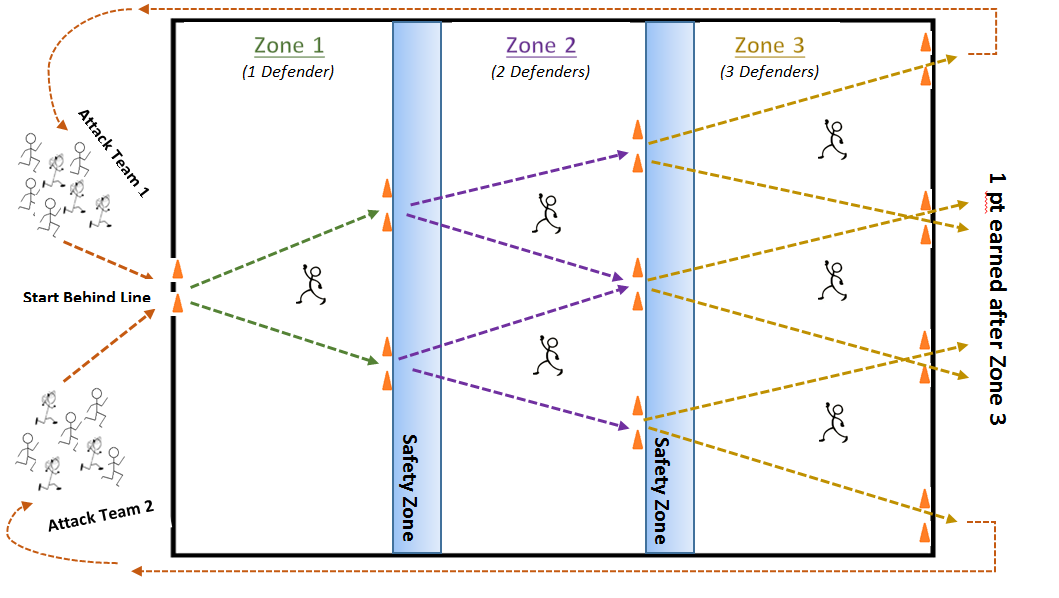
Purpose of Event: Provide students with a pre-designed “goal-oriented” tag game that incorporates boundaries, rules/consequences, and safety zones; all of which are flexible to tweaking.  Tag tactics are heavily emphasized, which can lead to Invasion/Territorial games.
Time: 20-25 minutes
Overall Goal of Game:  Score points for your team by running through the gates without being tagged by the defending team.  Likewise, the defense attempts to prevent runners from reaching the final zone.  All of this is done within a specified time frame. Rules for original game:

  1. One team is on defense, positioned to “guard the gates” in the play area, while the other 2 teams are the attacking teams on offense (see starting positions on the diagram).
  2. To score, attacking team players must stay in bounds, make it through 1st gate, then across zones 1-3 (only 1 gate per zone needed), all while w/out being tagged to score a point. If the player makes it past zone 3, the player then travels via the outside perimeter to the original starting point of the game, puts a popsicle stick in the team collection area (a hula hoop or bucket can be used) to score a point for her team, then the cycle starts again by attacking the zones from the start area.
  3. Safety zones (located directly after successfully passing each zone) are available for attacking team members to rest or strategize before entering the next zone.
  4. The defending team can only tag the attacking team players when they are in the attack zone. Defensive players are not allowed to change the zone they are assigned to defend from the start of the game.
  5. If the attacking player is tagged, she must immediately stop, return to the start area by traveling via the outside perimeter, and try again.
  6. Play each round for a designated time period (90 sec to 2 minutes is suggested); each team is on defense at least one time.

Variations: Add or remove gates as you see fit. For my students, I go 2, 2, 3, which I describe in the tutorial podcast below.

Concerns: Move safely around the gym. Make sure students are tagging appropriately and running through the gates only!!!
This idea is from: Kevin Vanderwal & Amy Staples, Physical Education Teachers, Sioux Falls School District.


SplitzAttack