Landmine Strike


Landmine Strike
 

State Standard: 1, 3, & 4

Equipment: Nets, Beachballs, Volleyball Trainers, Hula-Hoops Grade: 3-5 (2nd grade possibly)
Purpose of Event: Deactivate and collect the other team’s landmines using accurate volleyball skills!
Time: 18-25 minutes

Description:

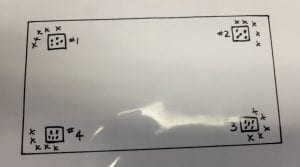
Each team begins on their own side of the court with landmines (hula-hoops) scattered across both sides of the net. I use 10 on each side. Players will use volleyball skills—serves, forearm passes, or sets—to send the ball over the net and try to land it or bounce it inside a landmine. When the ball successfully lands or bounces in a landmine, that landmine is considered “deactivated,” and a teammate may run to collect it and bring it safely back to their side. Players must be cautious: they are not allowed to step or stand on a landmine at any time; if they do, the landmine “explodes” and must be returned to the other team. Play continues until all landmines have been collected.

Concerns: Watch for players crossing paths, Be aware of the net and poles to avoid collisions,  No diving into landmines — protect knees, wrists, and heads, & Keep eyes up when moving so players don’t bump into each other.
This idea is from: This is my adaptation of the Volley Battleship by OpenPhysed


Around The World


Around The World
 

State Standard: 1, 3, & 4

Equipment: Cones, Yarn Balls, Gator Balls, Jerseys Grade: 3-5 (K-2 possibly)
Purpose of Event: Throwing, Cardiovascular Endurance, & Strategy
Time: 18-25 minutes

Description:

Depending on the gymnasium, you may use the lines that make a “Box” in each corner of the gymnasium, or you can mark those areas with cones. Additionally, cones should be placed around the center of the gymnasium, making a large rectangle. In the center of that rectangle is an assortment of yarn and gator balls. To start the activity, select two (2) students to be the throwers. Those students stay inside the large rectangle, and they will be throwing yarn balls and gator balls throughout the entire activity. Select four (4) students to be “Shaggers” Place these students on the outside of the gymnasium, and their job during the activity is to pick up the yarn balls and gator balls that have been thrown and throw them back into the large rectangle. The remaining students must find a “Box” in the gymnasium to stand in. The rules are that they need to have one foot in the “Box.” On the cue of the music, the students can stay in the “Box” for no more than ten (10) seconds. After that, they must either run to the next “Box” or skip it and keep moving to another “Box” or continue running. While running, the students in the large rectangle throw yarn and gator balls at them, trying to knock them out of the game. If a student is hit at any time, they become throwers! If the ball bounces off the floor, wall, another student, etc., they are out and become throwers! Headshots do not count! The game is over when one student is left. Rotate often and switch roles for the students so they can try the different roles in the game.

Concerns: 
This idea is from:


The Heart Behind Field Day


The following Twitter post (linked to a blog post) further explains that when we talk about the importance of Field Day, we’re not just talking about tradition—we’re talking about transformation. It’s a day that teaches life lessons: how to try, how to fail, how to support others, and how to have fun without needing to win.

Andy Milne and Drew Burris remind us that when we lead with Purpose and be visible: Perform, provide details with Planning, and carry it with Passion, we don’t just put on an event—we create a culture—a culture that values every student, a culture where movement is meaningful, a culture where one sponge relay can spark a whole new level of confidence in a child’s life.

Field Day is more than just a day. It’s a reminder of what education can be when heart, community, and play collide.

Pits & Alleys


Pits & Alleys
 

State Standard: 1, 3, & 4

Equipment: Several Items (listed below) Grade: K-5
Purpose of Event: Teamwork & Strategy
Time: 18-25 minutes

Description:

Pits and Alleys—Tag game involves strategy where taggers try to tag players and players try to avoid taggers by using the alleys and pits to their advantage. The POLY SPOTS are land mines—step on them, and you are out. The TIRES are booby traps—step in them, and you are out. The BOWLING PINS are hurdles to jump—knock them over, and you are out. The MATS are alligator pits—step on them, and you are out. The BALANCE BEAMS are a laser beam of light—step over it, and you are out. The ROPES and CONES make alleys—step over them or knock them down, and you are out. The TAGGERS are to tag students; if they do tag you, you are out. When out for one of the above reasons, you must sit on a designated MATS called the “PITS.” A new game starts when only a couple of people are left. New taggers must be selected.


Concerns: Students need to ensure they are following the game’s rules, exiting and entering the game through the correct doorways, and traveling in the right direction so they do not run into one another. 
This idea is from Kurt Skogstad, a retired Sioux Falls School District PE teacher.


Chain Reaction


Chain Reaction
 

State Standard: 1,  4

Equipment: Hula-hoops (at least one per student + extras for play), Beanbags (one per team), Timer or stopwatch, Cones to designate team zones Grade: K-5
Purpose of Event: Hand-eye coordination, teamwork, throwing accuracy, & sportsmanship
Time: 20-25 minutes

Organization: Spread hula-hoops around the playing area with ample space between them. Divide students into groups of 3 or 4 and assign each team a starting position (relay line formation). Place one hula-hoop per team at their starting point to begin the “chain.”
Description: Students line up in relay formation behind their team’s starting hula-hoop. The first student tosses the beanbag into the hula-hoop. If successful, they retrieve another hula-hoop and place it at the end (top) of their team’s chain. If unsuccessful, they retrieve the beanbag, return to the line, and the next teammate takes their turn. Continue until the timer runs out. Their goal is to have the longest chain when the timer is up. Variation: Allow teams to strategize whether to grab a new hula-hoop or steal one from another team when successful. Encourage strategic placement of the hula-hoop chain to maximize success.
Concerns: Ensure students are not getting a hula-hoop if they did not get it into their hula-hoop. Students must stay in line order as well. 
This idea is from Coach Byrd, Twitter.


Unifix Cube Warm-up


Unifix Cube Warm-up
 

State Standard: 1, 3, & 4

Equipment: Unifix Cubs, Buckets, and Cones Grade: K-2
Purpose of Event: Moving in General Space, Manipulative Skills, and Throwing
Time: 18-25 minutes

Organization:

Divide students into teams of 3-4, giving each team one empty bucket. In front of each team, set up three buckets in a line, similar to basketball lines, with 10-15 unifix cubes or small items in each. Each bucket should hold cubes of a single color to make sorting easier later. Players take turns running to any of the three buckets to grab one cube and bring it back to their team’s bucket. If a player takes the last cube from a bucket, they flip it over. The game continues until all buckets are empty. Once finished, teams sort the cubes by color and refill the buckets to prepare for the next class.

Variations: Instead of using Unifix Cubes, you can also use cutup pool noodles.

Concerns: Ensure the students take turns and stay in line. 
This idea is from Kris Smith, a Sioux Falls School District PE teacher.


Noodle Activities


Noodle Activities
 

State Standard: 1, 3, & 4

Equipment: Several Pool Noodles (long and short) for each student Grade: K-3
Purpose of Event: Balance, Chasing, Fleeing, Teamwork
Time: 18-25 minutes

Organization:
  Give each student their own pool noodle. 
Activities:

Noodle circles—-
Clap Game
      depending on grade, start with 2 or 3 (k,1,2)
      hold together with both hands, ends facing out
      throw in the air, clap, and catch only with your hands
      2 times in a row = getting one more from bucket
      must be verified by the partner
Walking Balance Game
      depending on grade, start with 2 or 3 (k,1,2)
      have them balance noodles on a body part and walk around
      top of head, back of hand, chicken wing elbow, etc
 
Resting Balance Game
      in a group of 2 or 3, one person lays flat on the back
      others go to bin one at a time and grab one circle
      carefully place the noodle on the resting person’s forehead wtih only one hand
      once it’s on, can’t touch it or move it
      repeat until it falls
 
Skyscraper
      same as above, but place noodles on the floor instead
Noodle Sticks—
Leaning Tower
      sticks that have ends that are angled 
      face partner, each has a stick, extend sticks to touch ends
      hold it with your right index finger next to your right leg (upright)
      partners say, ready to go, then release their noodles to run forward to catch their partner’s stick before it hits the floor
Ankle Biter
      same sticks as above
      face partner, each has a stick, extend sticks to touch ends
      that is your invisible circumference circle
      move about that circle trying to hit your partner’s ankles or shoes
 
Hornet Tag
      same sticks
      throw 4 or 5 sticks on the floor
      everyone vs. everyone, use the entire gym
      whoever wants to be a hornet can pick up a stinger(stick)
            off the gym floor.
      They chase and tag someone from the knee down, only
      after success, they drop their stinger and run away
      a person who got stung cannot pick the stinger that stung them
      they do whatever exercise you list for being stung, then resume the game
      you can pick up a different stinger after using one, but NO ONE has to pick up a stinger to become a hornet…it is optional

Concerns:

Be safe! Do not run into one another. 

This idea is from Jon Peterson, PE Teacher Robert Frost Elementary


Sneak Away


Sneak Away
 

State Standard: 1, 3, & 4

Equipment: 1 hockey stick per player, 20+ hockey pucks/yarn balls, & 16 cones (to mark goals in the corners of the gym).  Grade: 3-6
Purpose of Event: Striking with a long-handled implement/hockey lead-up skills
Time: 18-25 minutes

Organization:
  Divide the students into 4 equal teams. Put them in the four corners of the gym. I usually color-coordinate the goals with the player’s team color. 
Description:  Divide the class into four or more groups. Each group starts with five pucks/yarn balls by their goal. On the signal, all players run to another team’s goal, take a puck/yarnball, and stick handle It back to their own goal. There is NO defense in this game. At the end of the game, teams score one point for each puck/yarnballs in their goal. Variations: Try dispersing rather than collecting pucks. Try using a defensive player from each team.

Concerns:

Be safe while using the hockey sticks. Especially when the students are moving. Make sure students are not raising the hockey sticks above their heads. The blade must be on the floor unless they attempt to strike a puck/yarn ball. 

This idea is from: I have seen this played/called many different ways from various resources. 


GYM Setup

Rescue Football


Rescue Football
 

State Standard: 1, 3, & 4

Equipment: Several Footballs, Mats, and Pinnies. Grade: 3-5
Purpose of Event: Overhand Throwing (football), Teamwork, and Catching
Time: 20-25 minutes

Organization:  Divide the playing area in half, place three blue mats on each half of the gym, divide the students into two teams, spread the footballs evenly around the playing area.
Description:  Start with the teams on their own half of the playing area, select one player to stay on their side, this is the QB, the rest of the players go over and stand on the blue mats; they are the receivers.  The QB throws the footballs from his team’s side of the gym to his teammates on the blue mats; if they catch a football, they can go to their side of the gym and become QB’s.  If a QB’s pass is intercepted, they must return to the blue mats and again receive.  Keep playing until one team has everyone either as a QB or a receiver; if your team is all QB’s, you win; if your team is all receivers, you lose.
Concerns: Being safe while throwing the footballs (not at face). Make sure students are staying in their order. For the older kids: No cheating!!!! 
This idea is from: PE staff within Sioux Falls School District 


https://drive.google.com/file/d/1Mf5IUU9Aw_Cmlo5JI3ZcINIIhQECpIh1/view?usp=sharing

Pin-Galore Hockey


Pin-Galore Hockey
 

State Standard: 1, & 3

Equipment:  20 Plastic pins, Several gator-skin balls, Hockey Sticks (enough for two teams), and Poly Spots
Grade: 3-5
Purpose of Event: Using Long-Handled Implements while striking a Ball. 
Time: 15-20 minutes
Organizations:
Place 10 foam pins on each side of the gym on Poly Spots. Put several poly spots down the middle of the gym to separate into two halves. 
Description:
This is a modification to the regular game of floor hockey.  Instead of the typical scoring (puck into a hockey net), players will try to knock over the other team’s pins while striking a gator-skin ball with their hockey stick! If a player strikes the ball and it knocks down a pin from the other team their team scores a point (I use a digital scoreboard). Once the pin is down it stays down!!!!!  Once one team has knocked all the other teams pins down their team wins. Goalies are optional. If I do use a goal they must be in-between the pins to protect. 

Rules:
No high sticking. Both hands must be on the hockey stick. If a student breaks the rules they go to the penalty box (area where students have to do an exercise to get back in the game). 

Concerns: Be cautious when students are using their hockey sticks!!! 
This idea is from: Idea modified from physedgames.com