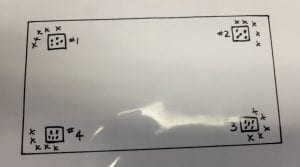
3-Team Continuous Tee-Ball


3-Team Continuous Tee-Ball
 

State Standard: 1, 3, & 4

Equipment: Two Batting Tees, Jerseys (3 colors), 4 Mats, large Poly spots, and bats Grade: 3-5 (2nd possibly)
Purpose of Event: Students will demonstrate striking, base running, and spatial awareness skills by safely hitting a ball off a tee and continuously advancing around bases to score points while avoiding getting three outs.
Time: 18-25 minutes
Organization:

  • Place 4 mats on the floor to represent bases (baseball diamond style).
  • Set up 2 batting tees at home plate (slightly spaced for safety).
  • Divide students into 3 groups:
    • Team A (Batting)
    • Team B (Batting)
    • Team C (Taggers/Fielders)
  • Provide taggers with safe tagging equipment (see options below).

Description: The game begins with the first player from both Team A and Team B hitting the ball off the tee and immediately running the bases, while the next batter in line prepares to go, keeping play continuous. Runners must travel in order from first to second to third and then home, and they are safe while standing on a base (mat). There is no limit to how many runners can be on a base at once, even if they are from different teams; however, once a runner steps off a base, they must continue to the next base without stopping or going back. A team earns one point each time a runner successfully returns to home plate.

Rules:
Players are out if they are hit by a ball, a ball is caught in the air, or they are forced out (per normal kickball rules). Teams continue batting until they either receive three outs and/or run out of players in their lineup. When this happens, that team rotates to the outfield, and the current outfield team becomes a batting team. Throughout the game, multiple runners from both teams are active at the same time, batters enter play continuously, and the activity maintains constant motion, quick decision-making, and high engagement.

Scoring:
We use three different-colored buckets, each corresponding to a team’s color. We also use popsicle sticks (or, during Easter time, plastic Easter eggs). Each time a runner from a team successfully rounds the bases twice before their team rotates to the outfield, they place one popsicle stick (or egg) into their team’s bucket. At the end of the game, we count the items in each bucket to determine the winning team.

Concerns:

  • Ensure all runners move in the same direction and stay aware of others
  • Clearly define safe zones (bases, aka mats)
  • Maintain proper spacing at batting areas (on-deck circle)
  • Require students to stay behind designated lines when not actively participating
This idea is from: 


Base Race Bonanza


Base Race Bonanza
 

State Standard: 1, 3, & 4

Equipment: 5 mats set up like 5 on a dice, yarn balls, & foam dice Grade: 3-5 (2nd possibly)
Purpose of Event: Students will develop locomotor skills, particularly running and base movement, while reinforcing accuracy in overhand throwing and evasion strategies. It also integrates cognitive learning by engaging students in math and literacy tasks as they move.
Time: 18-25 minutes

Organization:

Divide the class into 5 equal groups, one on each mat. The one in the middle is a thrower attempting to hit the runners (working on overhand throws). You could have a 6-member group retrieve the yarn ball. The other 4 groups are the runners.

Description:
Play begins when the teacher does: Option 1. The teacher calls out a number, and that is the number of bases they run. Option 2. Math problem (add, Sub, multiply), Option 3. Use dice to do the math problem. Option 4. Run using letters or spelling (e.g., run until you get to the letter M in the alphabet), 5. Run to the spelling of your name or spelling words. If you get hit, you become a ball retriever, or you must add bases. ** We use this activity to teach students how to run the bases (in which direction) before we play our T-Ball/Wiffleball games.** 

Concerns: Use only soft yarn or foam balls and require all throws to stay below the shoulders to minimize injury risk. Clearly define running lanes and space bases appropriately to prevent collisions, while ensuring students remain aware of their surroundings. Establish controlled throwing rules, designated retriever areas, and clear stop/play signals for safe game management.
This idea is from Kurt Skogstad, retired PE Teacher (Sioux Falls School District)


Egg Chase Base Race


Egg Chase Base Race
 

State Standard: 1, 3, & 4

Equipment: Batting tees (1 per group), Foam or whiffle balls, Large Poly Spots (to mark bases), Plastic Easter eggs (10–20 per group), A few Golden Ticket” eggs, Buckets/baskets (we use the large cubstakes), Tootsie Rolls (or small prizes). Grade: K-5
Purpose of Event: Students will strike a ball, run bases quickly, and make safe decisions while working cooperatively in a fun, Easter-themed game.
Time: 18-25 minutes

Organization:

Students are organized into small groups of one to two per station and arranged in a relay-style formation. Each station includes one tee, one batter, and one outfielder who stands on a large poly spot, along with a designated base marked by another large poly spot. A basket of eggs is kept by the teacher for distribution during the activity.

How To Play:

In this activity, the batter begins by hitting the ball off the tee and then runs to the base (large poly spot) and back as many times as possible. Meanwhile, the outfielder quickly retrieves the ball and returns it to the tee. Once the ball is returned to the tee, the runner must stop immediately. For scoring, each successful trip down and back earns the batter one Easter egg, which they collect at the end of their turn. After a 2-minute round, students (only the batter) open their collected eggs; if they find a Golden Ticket, they earn a Tootsie Roll. After each turn, students rotate roles: the batter becomes the outfielder, and the outfielder steps up as the next batter, continuing the cycle.

Variation:

For K-2 students, we use short-handled foam paddles instead of bats, plus putting the ball on the 8″ tall cone instead of a batting tee. 

Concerns: Use foam/soft balls only, Clear running lanes, emphasize awareness when striking the ball off the tee (do not throw the bats), running and fielding, & One batter at a time per station
This idea is adapted from Matt Eichel, a Physical Education Teacher at St. Ignatius School, whose original idea was called “Race To the Base.”


Shamrock Send-Off


Shamrock Send-Off
 

State Standard: 1, 3, & 4

Equipment: Floor hockey sticks (one per student), 6–12 foam or plastic balls (Shamrocks), 1 long rope or jump rope (The Rainbow), Cones to mark boundaries (optional), & Gold Coin cards or tokens for scoring Grade: K-5
Purpose of Event: Students will use hockey sticks to send shamrocks under the rainbow rope into the opposing team’s field while working cooperatively to defend their area and earn gold coins for their team.
Time: 18-25 minutes

Organization: 

  1. Divide the gym into two equal treasure fields.

  2. Stretch a rope across the center about 2 feet off the ground to create the Rainbow Line.

  3. Split students into two teams of leprechauns.

  4. Each student gets one hockey stick.

  5. Place several Shamrocks (balls) in each team’s Shamrock Garden near their end line (4–6 balls per team to start).

  6. Place a stack of Gold Coin cards or tokens near the teacher.


How To Play:

When the teacher shouts “Send the Shamrocks!”, players begin using their hockey sticks to send their team’s shamrocks toward the rainbow. Players must hit or push the shamrocks with their hockey sticks. The shamrocks must travel under the rainbow rope to count. Players can defend by stopping or redirecting shamrocks with their sticks. Players should spread out to guard open space and protect their side.

** If a shamrock crosses the opponent’s end line, the opposing team earns one Gold Coin.**

The student (s) then strike (with their hockey stick) the shamrock back into play, allowing the game to continue.

When the Game Ends

Play for 2–4 minutes or until the teacher calls “Treasure Time!”

Teams count how many Gold Coins they collected.
The team with the most gold coins wins the treasure!

Variation:

Instead of using hockey sticks, the K-2 students can kick or use a short-handled implement to strike the “shamrocks” under the rainbow. 

Concerns: 
This idea is adapted from a game called “Boundary Ball” by Jerry Poppen


Volley Duel


Volley Duel
 

State Standard: 1, 3, & 4

Equipment: NowNets (by Gopher Sport) – 1 per 4 students, Beachballs – 1 per NowNet, Cones (optional) – to mark play areas, & Large Poly Spots Grade: 3-5 (possibly 2nd)
Purpose of Event: Practice basic volleyball skills — forearm pass, set, and underhand serve — while working cooperatively with a partner to keep the beachball from landing on their side of the net.
Time: 18-25 minutes

Organization
Place the NowNets around the gym, ensuring each game area has enough space between others for safety and easy movement. Group students into pairs, with two players on each side of the net for a total of four per game area. Provide each group with one beach ball for play. 

Volley Duel
Each side of the net has two players working together. To begin play, one team serves the beachball underhand over the net. The teams then rally back and forth, doing their best to keep the beachball from touching the ground on their side. Players may use sets or passes to return the ball, focusing on controlled and cooperative hits rather than power. If the beachball lands on one side, the opposing team earns a point and serves next. After two to three minutes of play, teams should rotate opponents or switch partners to keep the activity engaging and inclusive.

Concerns: Ensure students take turns and use appropriate volleying skills. 
This idea is from Joe McCarthy, Meadow View Elementary, Minnesota


Landmine Strike


Landmine Strike
 

State Standard: 1, 3, & 4

Equipment: Nets, Beachballs, Volleyball Trainers, Hula-Hoops Grade: 3-5 (2nd grade possibly)
Purpose of Event: Deactivate and collect the other team’s landmines using accurate volleyball skills!
Time: 18-25 minutes

Description:

Each team begins on their own side of the court with landmines (hula-hoops) scattered across both sides of the net. I use 10 on each side. Players will use volleyball skills—serves, forearm passes, or sets—to send the ball over the net and try to land it or bounce it inside a landmine. When the ball successfully lands or bounces in a landmine, that landmine is considered “deactivated,” and a teammate may run to collect it and bring it safely back to their side. Players must be cautious: they are not allowed to step or stand on a landmine at any time; if they do, the landmine “explodes” and must be returned to the other team. Play continues until all landmines have been collected.

Concerns: Watch for players crossing paths, Be aware of the net and poles to avoid collisions,  No diving into landmines — protect knees, wrists, and heads, & Keep eyes up when moving so players don’t bump into each other.
This idea is from: This is my adaptation of the Volley Battleship by OpenPhysed


Batter Up


Batter Up
 

State Standard: 1, 3, & 4

Equipment: Mats, Cones, long-handled implements, and balls. Grade: 3-5 (K-2 possibly)
Purpose of Event: Striking with a Long-Handled Implement (S1.E25), Fielding/Catching a batted ball (S1.E16)
Time: 18-25 minutes


Organization: Place mats for boundaries between ‘batting cages’ facing a long wall for more space to use and hit into (dependent on your gym size). Place hitting tees or large pylons to hit from (students can have the option to throw and hit their own ball). Across from the hitting tees, place another pylon as the ‘base.’ (Feet poly spots are optional for hitters)

Description:

The batter hits the ball into the ‘field,’ drops the bat, runs to the ‘base’ (pylon), touches the pylon with their hand, and then runs back to the batting tee (home) and touches it.

The fielder retrieves and returns the ball to the batting tee (home).

SAFE = If the batter gets to the ‘base’ and back ‘home’ first, the batter is SAFE.

OUT = If the fielder retrieves the ball and touches ‘home’ first OR they catch the ball before it hits the ground, the batter is OUT.

The batter then goes to the back of the fielder line. The fielder then becomes the next batter.

Variations:

  • Make the playing area bigger or smaller depending on grade level and ability
  • Make the batter run to the base and back more times
  • Make the fielder do an exercise before they have to get the ball
Concerns: Review how to keep your eyes up to ensure you will not run into another fielder or batter. Cannot obstruct another field or batter’s way to the ball or base. RPS if there is a tie at home
This idea is from Matt Eichel, a Physical Education Teacher at St. Ignatius School. 


Sneak Away


Sneak Away
 

State Standard: 1, 3, & 4

Equipment: 1 hockey stick per player, 20+ hockey pucks/yarn balls, & 16 cones (to mark goals in the corners of the gym).  Grade: 3-6
Purpose of Event: Striking with a long-handled implement/hockey lead-up skills
Time: 18-25 minutes

Organization:
  Divide the students into 4 equal teams. Put them in the four corners of the gym. I usually color-coordinate the goals with the player’s team color. 
Description:  Divide the class into four or more groups. Each group starts with five pucks/yarn balls by their goal. On the signal, all players run to another team’s goal, take a puck/yarnball, and stick handle It back to their own goal. There is NO defense in this game. At the end of the game, teams score one point for each puck/yarnballs in their goal. Variations: Try dispersing rather than collecting pucks. Try using a defensive player from each team.

Concerns:

Be safe while using the hockey sticks. Especially when the students are moving. Make sure students are not raising the hockey sticks above their heads. The blade must be on the floor unless they attempt to strike a puck/yarn ball. 

This idea is from: I have seen this played/called many different ways from various resources. 


GYM Setup

Crazy Baseball


Crazy Baseball
 

State Standard: 1, 2, 3, & 4

Equipment: 1 bat/racquet, ball set of bases for each pair of teams (I have enough room to have 3 games going on at once, so I need 3 of everything, my gym is about 70′ X 40″) I use Polly-spots for bases and Koosh balls/paddles
Grade: 3-8
Purpose of Event: Work on baseball/softball skills, Throwing, striking, catching, running with minimal standing around
Time: 15-20 minutes
Description:

Divide into teams of  3 or 4.  One team goes to the field the other is up to bat.  I have 6 teams playing, so I always have 3 batting teams and 3 fielding teams. Remind the kids, they are only playing their batters, don’t worry about the other games going on beside you.  One fielding student needs to be at each base (if you have teams of 4, the fourth player starts at the pitching position, and after the ball is batted, covers home).  The batter pitches to them self, and then runs AROUND ALL of the bases.  (I stress running around, because I use Polly-spots as bases and their isn’t a lot of extra room.)  The runner runs around all the bases, everything is a home run.  They do not stop at any base. While the batter is running, the fielding team, gets the ball, throws it to first, then second, then third then home.  If the fielding team gets the ball “home” before the runner gets home, the batting team doesn’t get a point/run.  If the runner gets “home” before the ball, the batting team earns a point/run.  If the ball is caught, it is not an out, it has to be thrown to the bases in order, every time.  After all 3 or 4 batters have batted one time, they go to the field, and the fielding team bats.  If your teams only have 3 players, have the first base player cover home, AFTER they throw the ball to second.

I let them play for about 5 minutes and then switch the teams, so they are playing other teams.  This game rewards great throws and catches, and gets them running and moving.  The batters only are waiting for 2-3 other batters, so they aren’t in line forever and bat every inning.  Fielders always get the ball, and they all have to throw and catch.

I have also used scoops to catch with for that unit!  Really a challenge!  Have them do all of the catching/throwing/”batting” with the scoops and see how they do!

Concerns: Don’t throw the bat!  Make sure to have space between each field.  Don’t let teams purposely interfere with other games. Use soft balls, lots of action!
This idea is from: SHAPE America 2018 National Convention: Nashville, TN


Batting Skills


Batting Skills

State Standard: 1, & 4

Equipment:Bats, batting tees, wiffle balls, and poly spots Grade:  3-5
Purpose of Event:  Eye-hand coordination, grip, stance, and swing
Time: 20-25 minutes

Introduction:  Students will sit in a horseshoe formation while I review the basic batting stance, hand position, grip, and swing with the students.

Batting:

  1. Students will take turns practicing their stance, gripping the bat and swinging through an imaginary ball.
  2. Bat around: Set up four tees on one end of the gym.  At the opposite end place poly spots in a semicircle.  There should be a poly spot for each child that is not batting.  Place on student at each poly spot and one at each tee. All fielders not batting must remain on the spots until each batter hits.  On the teacher’s signal each batter swings the bat and hits the ball in the direction of the fielders. Once all batters have hit the ball the fielders closest to the balls pick them up and return them to a tee and then return to their spot.  Students then rotate counter-clockwise one spot or tee. Repeat this until everyone has batted four times.
  • Variations: Depending on the skill level and grade level, some students may be ready to bat a pitched ball.  The teacher may stand in place of a tee and pitch to that student.
  • If the teacher is not pitching he/she should be observing and helping the batters with their stance, grip, and swing.
Concerns:  Move carefully in personal space with Wands.
This idea is from: Myself as well as Tanner Ross & Kevin Tiller (seen below).